
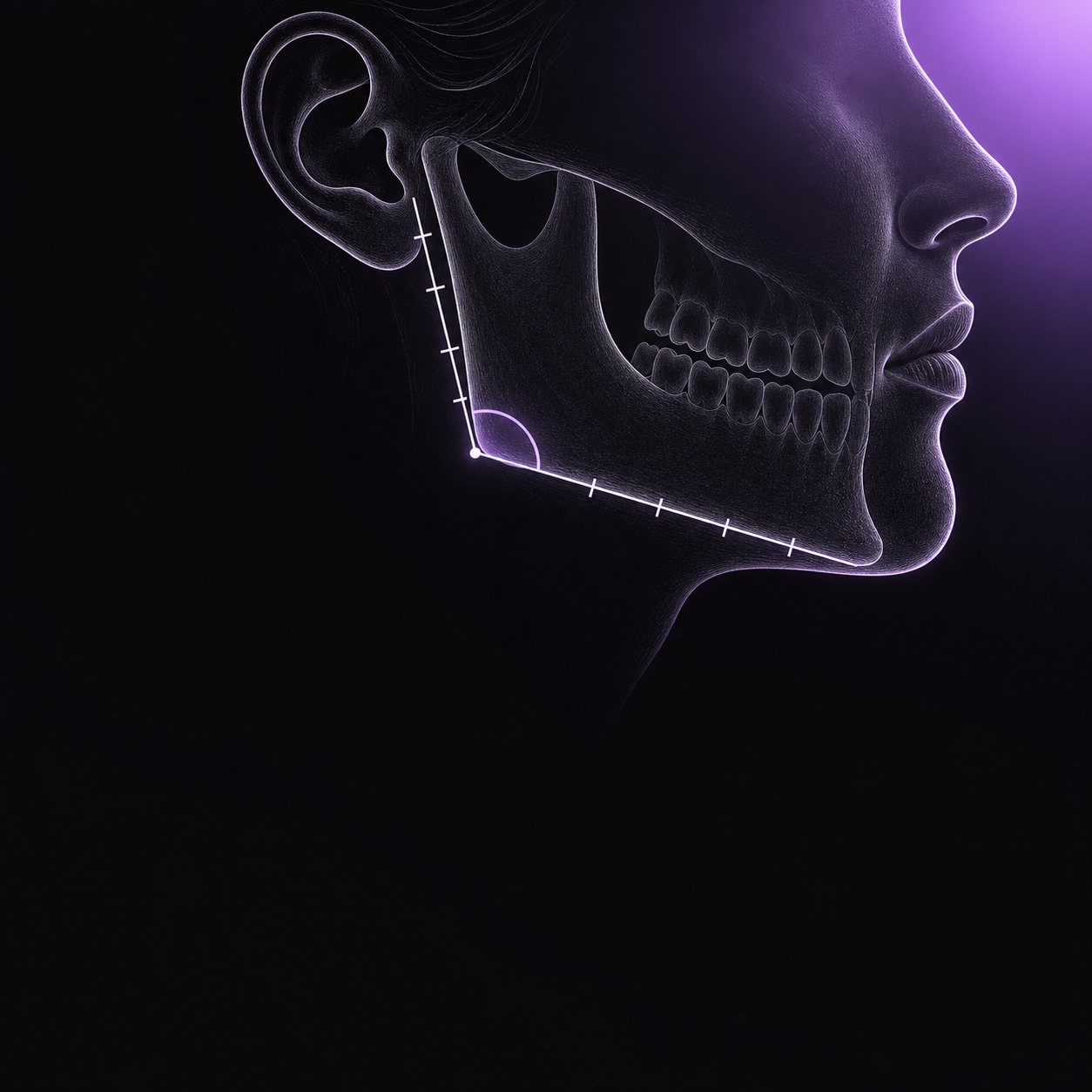
Most jaw-related searches are vague — sharper jawline, more defined jaw, jaw exercises. Gonial angle is the rare exception: an actual number, measured the same way every time, at the corner where your jawbone turns from vertical to horizontal. It's also one of the few facial-structure terms where "genetic vs. changeable" has a genuinely satisfying, specific answer instead of the usual "it's complicated."
What it actually measures
The gonial angle is the angle formed at the gonion — the point where your lower jawbone (the mandible) turns the corner from the vertical ramus up near your ear to the horizontal body running along your jawline. A smaller, more acute angle reads as a sharper, more square jaw. A larger, more obtuse angle reads as softer and rounder. Aesthetic studies generally put the range associated with a defined masculine jawline around 120–130 degrees, and a softer, more classically feminine one around 125–135 — overlapping ranges, not a hard cutoff, because plenty of attractive faces of either sex sit outside those bands.
The underlying bone structure comes overwhelmingly from genetics. Mandible shape and growth pattern is substantially heritable, and androgen exposure during puberty is a big part of why male jaws tend to grow more angular than female ones on average. This is the part that's genuinely fixed once your skeleton finishes growing.
The part that isn't bone at all
Here's the piece that gets skipped constantly, and it's the most useful thing in this whole topic: the masseter muscle — the main chewing muscle sitting right over the angle of your jaw — can visibly widen and sharpen that area without touching the bone underneath at all. Heavy, repeated chewing trains this muscle the same way any muscle responds to repeated use, and a well-developed masseter can shift how sharp your jaw angle looks by a real, measurable amount — commonly cited in the 3 to 12 degree range — while the actual bone angle underneath hasn't moved a millimeter.
This is exactly the mechanism behind the "chew gum for a jawline" idea that circulates constantly, and it's not pure nonsense the way mewing's bone-reshaping claim is — a trained masseter is a real, visible change. What it isn't is a way to change your underlying bone structure, and pushing it hard enough to matter comes with a real cost: overworking the masseter is a documented contributor to jaw tension and TMJ issues, which is a bad trade for a muscle most people never think about using deliberately.
Why it changes with age, independent of everything above
Your gonial angle isn't fixed for life even without any muscle training. It's typically more obtuse in infancy, becomes more acute through childhood and adolescence as the jaw grows and matures, and then tends to open back up again later in life as bone resorption sets in — a genuine, gradual, unavoidable structural change, most noticeable after tooth loss. None of that is about muscle, fat, or lifestyle. It's just how mandibular bone behaves over a lifespan, running in the opposite direction from what most people assume "aging softens the jaw" means.
What the research actually says about attractiveness
This is one of the more consistent findings in facial-attractiveness research rather than a modest, context-dependent one: a defined jawline shows up as a robust predictor of perceived male attractiveness across multiple studies and multiple populations, not just one cultural context. That's a stronger claim than we'd make for most single facial features — it's worth knowing which findings in this space are actually well-replicated and which are thinner, and this one leans toward the well-replicated side.
Jawline definition is one of the categories broken down in a full face score, alongside the rest of what's actually measurable in a photo — not because one number decides anything on its own, but because knowing whether it's bone, muscle, or just the angle you took the photo at changes what's actually worth doing about it.