
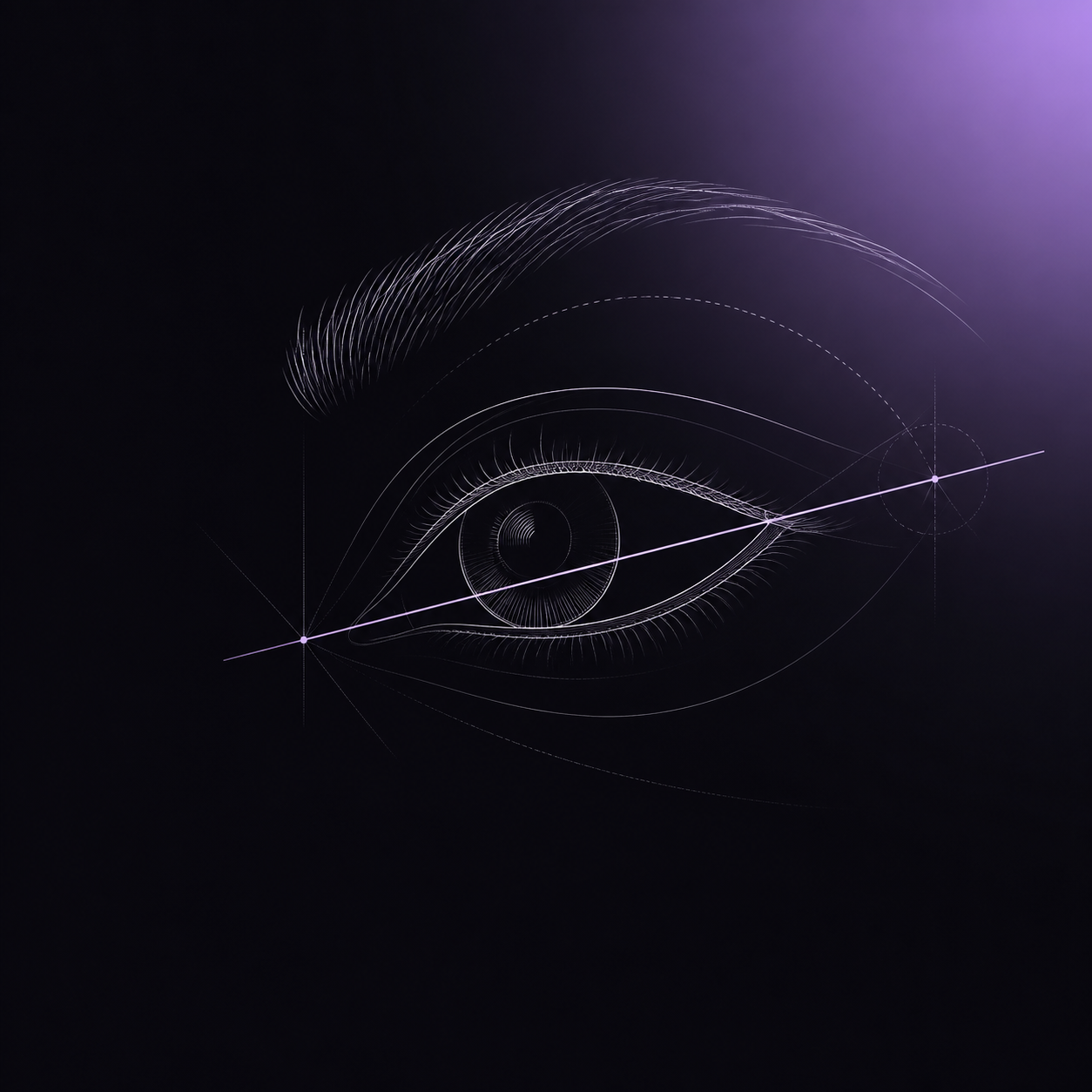
"Hunter eyes" is one of those terms that showed up on TikTok and immediately had its own vocabulary: hunter eyes versus prey eyes, hooding, upper eyelid exposure, filters that simulate it before you've even looked up what canthal tilt means. Videos tagged with it have racked up tens of millions of views. It's also one of the more confidently misused terms in the whole looksmaxxing conversation, because most explanations flatten four or five separate facial features into one word.
Here's what it's actually built from — and which part of it you can put an actual number on.
What "hunter eyes" is describing
Strip away the branding and hunter eyes is shorthand for a cluster of features showing up together, not one trait:
- Positive canthal tilt — the outer corner of the eye sits higher than the inner corner, giving the eye an upward angle.
- Deep-set positioning — the eyes sit further back in the orbital socket, often paired with a more prominent brow ridge.
- Hooding — less visible upper eyelid, which reads as a narrower, more focused gaze rather than a wide-open one.
- A short brow-to-lid distance — the eyebrow sits close to the eyelid crease instead of higher above it.
"Prey eyes," the term's paired opposite, is roughly the inverse of all four at once: negative tilt, rounder and more protruding, more upper lid visible, more space between brow and lid.
That's the part almost every short explainer skips. Hunter eyes was never really describing one measurement — it's a whole eye-region archetype, and canthal tilt is just the one piece of it that happens to be easy to name and easy to see in a photo.
Where the term actually comes from
Worth being direct about this: "hunter eyes" and "prey eyes" didn't originate in facial-aesthetics research. The vocabulary comes out of online lookism and self-improvement forums, built around the idea that a sharper, more hooded, upward-tilted eye reads as dominant and predatory, while a rounder, more open eye reads as passive. It's an evocative frame — tiger and cheetah eyes versus deer eyes — but it's a cultural narrative, not a finding. There's no research establishing that a hooded, positively-tilted eye is universally rated more attractive than a rounder one; eye shape preference varies across studies, populations, and — a lot — across individual taste. Treat the "dominant predator" framing as marketing language for a look, not as a scientific verdict on what works.
The one part you can actually measure
Of the four features bundled into "hunter eyes," canthal tilt is the one with a clean, objective definition: the angle between a line drawn through your inner and outer eye corners and true horizontal. Positive tilt (outer corner higher) versus negative (outer corner lower) is a real, measurable quantity from a single photo. Hooding, deep-set positioning, and brow-to-lid distance are real too, but they're read qualitatively — there's no equivalent single-number version of "how hooded" an eye is the way there is for tilt in degrees.
That's exactly why canthal tilt became the entry point for the whole "hunter eyes" conversation: it's the one piece anyone can actually check, so it ended up standing in for the whole look in casual conversation, even though it's only one of the four features doing the work.
What this means if you're chasing the look
If "hunter eyes" is the goal, canthal tilt is a genuine, checkable starting point — but going in expecting it to be the whole picture sets up a letdown. A strongly positive tilt on an otherwise round, unhooded eye with a lot of brow-to-lid space won't read the same way as the archetype, because the other three features are still doing real work in how the look is actually perceived.
We built a free canthal tilt calculator that measures exactly this — your eye angle in degrees, positive, neutral, or negative, from a photo, entirely on your device. It won't tell you about hooding or brow position; nothing automated cleanly does yet. But it'll tell you, accurately, the one number in this whole conversation that actually has one.