
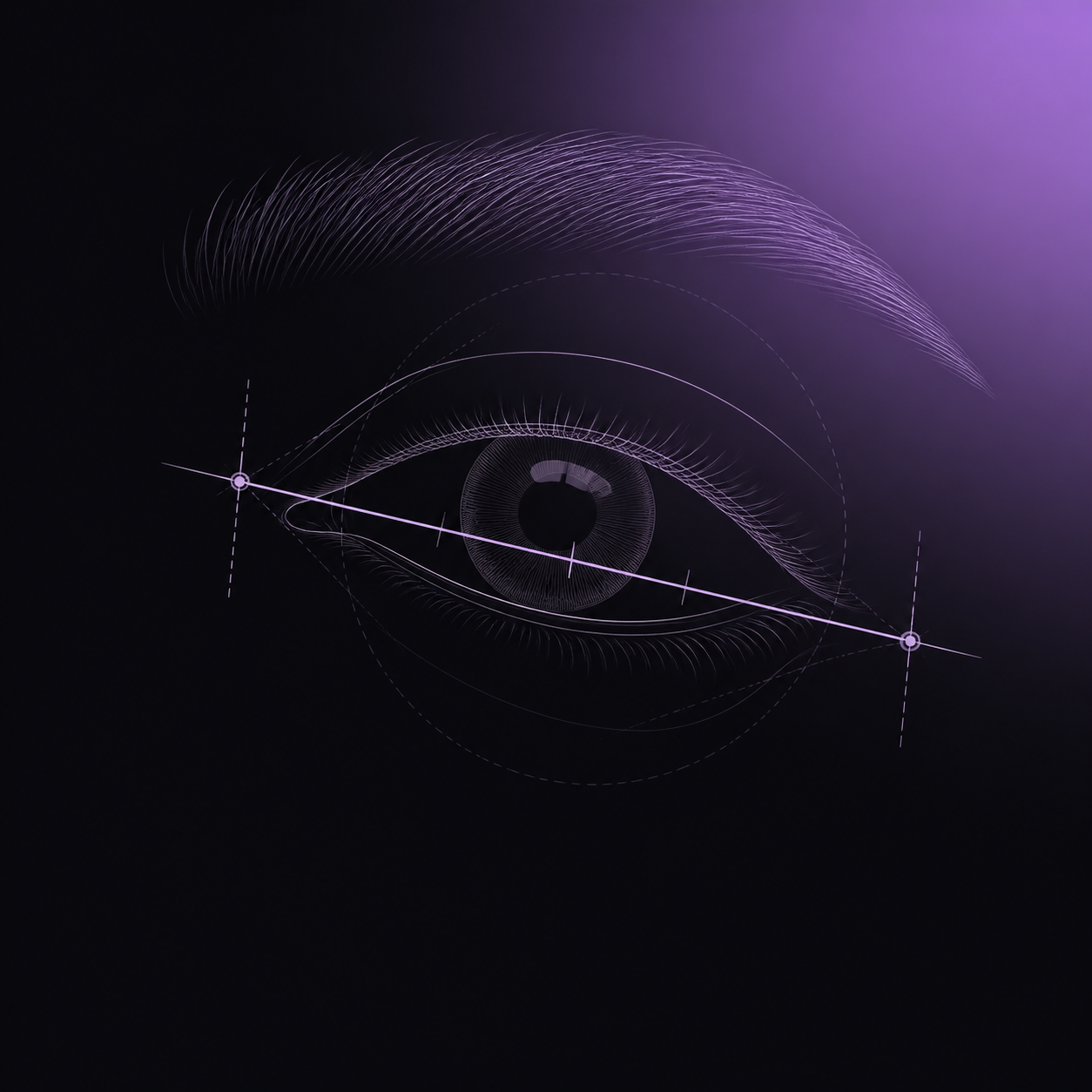
Most people who search "negative canthal tilt" aren't doing idle research. They noticed the term somewhere, checked a mirror or a photo, and are now trying to work out whether something is wrong with their eyes. It's worth answering that directly before getting into the mechanics: no. It's one of the most common, well-understood, and least medically significant things you can measure on a face. The worry around it is almost entirely a social media artifact, not a clinical one.
Here's what's actually going on.
What causes it
Canthal tilt — the angle between your inner and outer eye corners — is set overwhelmingly by genetics: the shape of your orbital bone and where your lateral canthal ligament attaches to it. A negative tilt, where the outer corner sits lower than the inner corner, is a normal anatomical variation that's largely fixed by the structure you were born with, not something that develops because of anything you did or didn't do.
Aging does play a real, secondary role. Over decades, the ligament holding the outer corner in place gradually loosens, and collagen and midface volume loss pull that corner down slightly further. That's a genuine, documented effect — but it's gradual and additive to whatever your baseline tilt already was, not the reason someone has a negative tilt in their 20s.
The "tired" perception is real. The "problem" framing isn't.
This is the part worth being precise about, because both extremes you'll find online are wrong. It's true that a negative tilt reads as tired or sad in still photos, even on a well-rested face — that's a documented perceptual effect, not something people are imagining. What isn't true is the jump from "reads as tired in a photo" to "is a flaw that needs correcting." Medically, negative canthal tilt is a normal variation carried by a huge share of the population, including plenty of faces nobody would describe as tired-looking in person, where expression, movement, and context do a lot of work a static photo can't.
The idea that it's unattractive and needs fixing comes from online beauty-standard communities, not from anything in the medical or aesthetics research literature. Canthoplasty — the surgery that alters canthal tilt — is a real procedure with real risks, and it exists for people with genuine functional or reconstructive needs, not as a default response to a number that shows up on a facial analysis account.
What's actually worth doing with this information
If you've measured a negative tilt and it's bothering you, the honest options are limited and unglamorous: makeup techniques that visually lift the outer corner in photos, understanding that static photos exaggerate the effect compared to how you're perceived in motion, or — if it's genuinely affecting how you feel day to day — a conversation with an oculoplastic surgeon about what canthoplasty actually involves, not a tutorial video. What's not worth doing is treating a screen number as a verdict on your face.
If you want the number itself, our free canthal tilt calculator measures your exact angle in degrees, entirely on your device — the same starting point, minus the panic.