
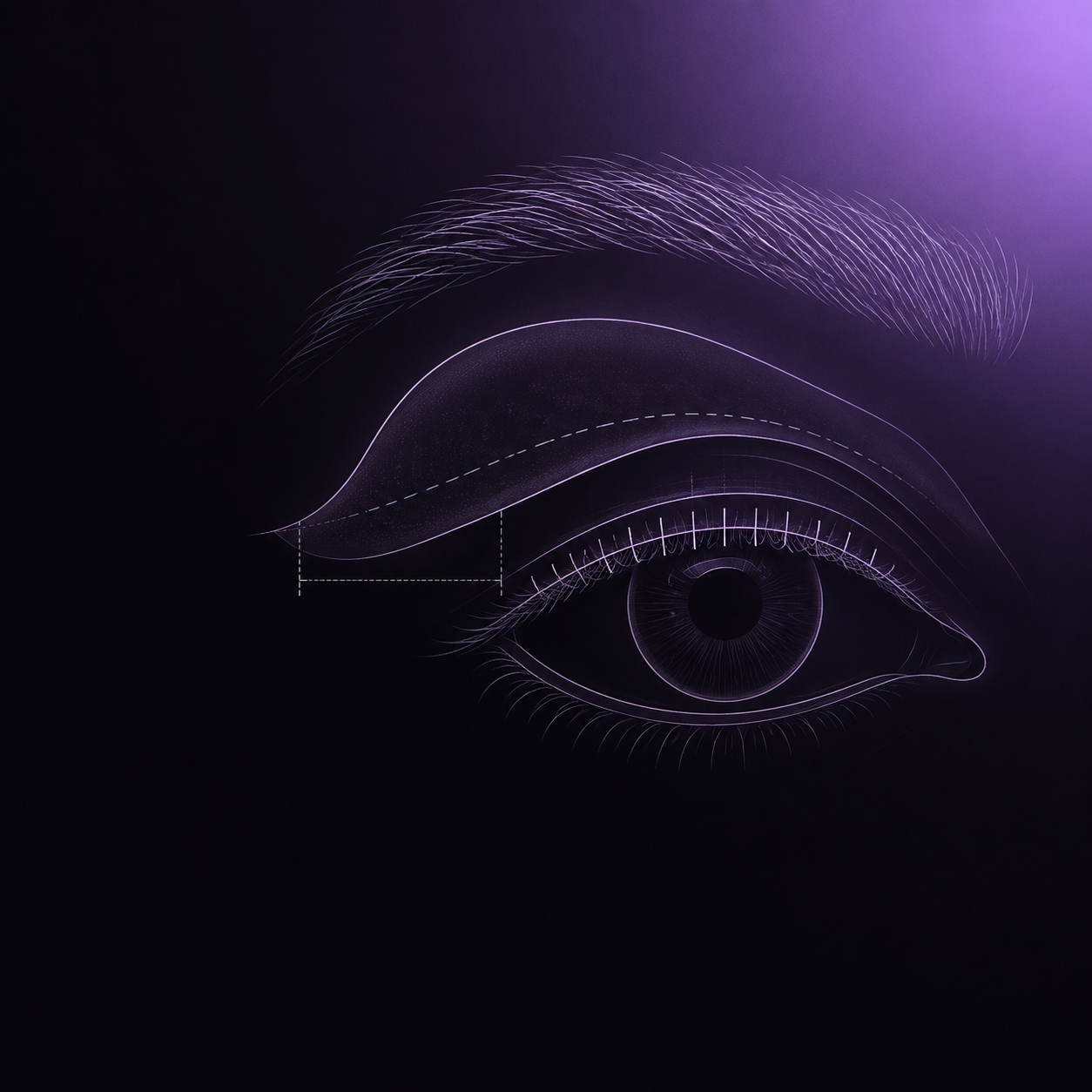
Hooded eyes get searched constantly, and for two very different reasons. Some people are just curious what the term means. Others found it while trying to work out if something about their own eyes is a flaw. Both groups usually end up on the same makeup-tutorial content, which answers "how do I work around this" without ever answering "what is this, actually."
Here's the actual anatomy.
What a hooded eye actually is
A hooded eye is what happens when the upper eyelid crease is partially or fully covered by the skin and fat pad sitting above it, reducing or eliminating the visible strip of eyelid between your lash line and your crease when your eyes are open. It's not a different eye shape so much as a different amount of coverage over the same underlying structure — the crease is usually still there, it's just not visible from the outside.
Three things drive how much hood you have: where your eyebrow naturally sits, how deep your eye socket is, and how much fat sits in the pad above your eyelid. All three have a real genetic floor — some people are simply built with a lower brow position or a larger sub-brow fat pad, full stop, independent of age or anything else.
The genetics-versus-aging split, and why both answers online are half right
This is the same pattern we've covered with canthal tilt, and it holds here too: genetics sets the baseline, aging can add to it, and the two get conflated constantly online.
The floor is genetic. If you've had visibly hooded eyes since your twenties, that's your underlying anatomy, not a sign of anything happening early. Separately, real age-related hooding exists — as the brow and forehead descend gradually and upper eyelid skin loses elasticity over decades, eyes that started with little or no hood can develop one, and eyes that already had some hood can gain more. Both of these are true at once for most people: a genetic starting point, plus a slow additive effect over time that has nothing to do with how "hooded" you were in your twenties predicting anything about you now.
Does it actually make you less attractive?
Direct research specifically isolating hooded eyelids from every other facial feature is thin — the same limitation that shows up whenever someone tries to study one facial feature in isolation. What does exist doesn't support hooding as a negative on its own. It shows up constantly among faces widely described as striking rather than flawed, and the cultural read on it — intensity, a "smoldering" quality — is arguably a more accurate description of how it actually functions in a full face than either the tutorial-content framing (a problem to conceal) or the insecure-search framing (a flaw to worry about).
This is also the piece we flagged as unfinished in the Hunter Eyes post: hooding is one of the four features bundled into that whole trend term, and it's the one piece of it that still doesn't have a clean, single-number measurement the way canthal tilt does. That's not a gap in how thorough this article is — it's a gap in what's currently measurable from a photo at all.
What's actually worth doing with this
If hooding is something you're curious about rather than worried about, there's nothing here that needs fixing — it's ordinary anatomy, not a defect with a checklist of corrections. If it's genuinely bothering you day to day, the same honest options apply as with any structural eye-area feature: makeup techniques built specifically for hooded lids exist and work well, and if it's a functional issue (hooding severe enough to actually obstruct vision, which is a real, different, medical thing) that's a conversation for an ophthalmologist, not a content creator.
We don't have a hooded-eyes calculator — as covered above, there isn't yet a clean way to reduce it to one number the way canthal tilt reduces to a degree measurement. What we do have is the canthal tilt calculator for the one piece of your eye area that does have an actual number attached to it.